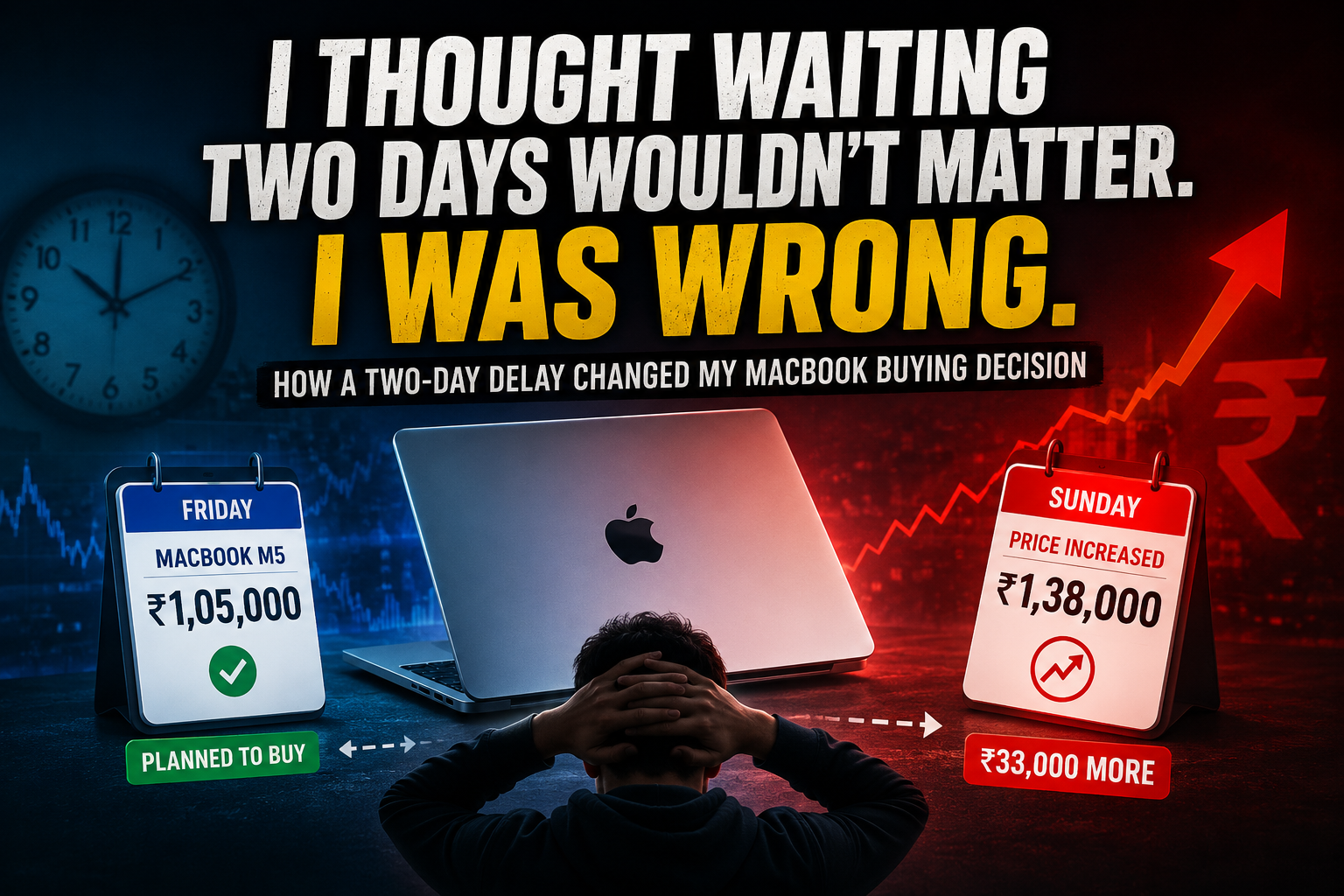
How a Two-Day Delay Changed My MacBook Buying Decision and What It Says About Today’s Tech Market!
Buying a premium laptop isn’t an everyday decision. For most people, it’s a purchase that involves months of planning, comparing options, setting aside savings, and convincing themselves that spending more than ₹1 lakh is worth it. I was in exactly the same situation.
For weeks, I had been researching laptops. I compared Windows machines with Apple’s latest MacBook M5, watched reviews, read user feedback, and evaluated whether the higher price was justified. My conclusion was simple: although the MacBook M5 was expensive, it was powerful enough to meet my needs for the next seven or eight years. Instead of upgrading every three or four years, I wanted to invest once in a device that would last.
To check the pricing, I visited a nearby Apple-authorized store. The MacBook was listed at around ₹1.19 lakh. After applying the store offer and a bank card discount, the effective price came down to approximately ₹1.05 lakh. That felt like a great deal. It was still a significant investment, but one I was finally prepared to make.
Instead of purchasing it immediately, I decided to wait until Sunday, just two days later. My plan was simple. I wanted to visit the store with my family, spend the weekend together, and complete the purchase.
The next evening, while scrolling through X (formerly Twitter), I came across posts reporting that Apple had increased the prices of several products, including MacBooks, Macs, and iPads. At first, I assumed it was just another social media rumour. To confirm, I called the same store.
The salesperson told me the laptop was already out of stock, and the next shipment would arrive with the revised pricing.
In a matter of hours, the deal I had carefully planned had disappeared. The laptop I intended to buy for around ₹1.05 lakh would now cost me roughly ₹33,000 more.
My first reaction was disappointment. I kept asking myself one question: Should I have bought it immediately?
But after thinking about it for a while, I realized this wasn’t just my story. It reflected a much bigger shift happening across the global technology industry.
This Isn’t Just About Apple
It’s easy to assume that Apple simply decided to increase prices. However, the reality is much more complex. The technology industry is facing several economic and manufacturing challenges at the same time, and those challenges eventually reach consumers through higher prices.
Whether you’re buying a MacBook, a Windows laptop, an Android smartphone, or an iPhone, every modern device depends on a global supply chain. A single laptop contains components sourced from different countries, including processors, memory chips, storage, displays, batteries, wireless modules, and power management chips. If the cost of even a few of these components increases, manufacturers have to decide whether to absorb the additional expense or pass it on to customers.
More often than not, consumers end up paying the difference.
The Growing Cost of Semiconductor Chips
Semiconductors are the heart of every electronic device. They power smartphones, laptops, gaming consoles, smart TVs, cars, and even household appliances.
Over the past few years, semiconductor manufacturing has become significantly more expensive. Producing advanced chips requires cutting-edge fabrication plants, highly specialized equipment, and billions of dollars in investment. Only a handful of companies in the world have the capability to manufacture the latest generation of chips at scale.
At the same time, demand has continued to grow rapidly.
Artificial intelligence has completely changed the priorities of the technology industry. Companies are no longer building devices that simply run software efficiently. They’re now designing hardware capable of processing AI tasks locally, without relying entirely on cloud servers.
This means more powerful processors, dedicated AI engines, faster memory, and improved thermal designs. All of these innovations increase production costs.
The AI revolution isn’t limited to ChatGPT, Gemini, or other AI assistants. It has triggered one of the biggest hardware races the technology industry has ever seen.
Laptop manufacturers now advertise AI PCs. Smartphone brands promote on-device AI features. Chipmakers compete to build faster neural processing units capable of running increasingly complex AI models.
While these innovations improve user experience, they also make devices more expensive to manufacture.
Consumers often see only the final retail price. They rarely see the billions of dollars companies invest in research, semiconductor fabrication, and advanced manufacturing technologies.
Consumers often see only the final retail price. They rarely see the billions of dollars companies invest in research, semiconductor fabrication, and advanced manufacturing technologies.
Apple Isn’t the Only Brand That Could Be Affected
Although my experience involved a MacBook, this trend extends far beyond Apple.
Major brands such as Dell, HP, Lenovo, ASUS, Acer, Samsung, Xiaomi, OnePlus, Google, and Microsoft all depend on advanced semiconductor technology. If manufacturing costs continue to rise, these companies may also face pressure to revise pricing or reduce promotional offers.
This means today’s price increase could become tomorrow’s industry-wide trend.
What Does This Mean for Smartphone Buyers?
Many people are currently planning to upgrade their smartphones during upcoming festive sales. However, buyers should prepare for a changing market.
Instead of dramatic discounts, we may begin seeing smaller price cuts, shorter promotional campaigns, and higher launch prices for premium devices.
Brands may also choose to reduce bundled accessories, limit exchange bonuses, or introduce AI features only in more expensive models.
In other words, the definition of “value for money” may begin to change.
Should You Buy Now or Wait?
There is no universal answer, but one thing is clear: if you genuinely need a device and have found the right option at a reasonable price, the right time to buy is today, don’t delay unnecessarily.
If you’ve already researched the product thoroughly, found a genuine discount, and believe the device will serve you well for many years, delaying the purchase simply to save a little more may not always be the best strategy.
On the other hand, if your current device still performs well and your purchase isn’t urgent, waiting for a major sale or the launch of a newer model can still make financial sense.
The key is to avoid making decisions based purely on emotion or fear of missing out.
My Biggest Lesson
Looking back, I still don’t know whether waiting was the wrong decision.
Perhaps another attractive offer will appear in the coming months. Perhaps prices will stabilize. Or perhaps I’ll eventually buy the same laptop at a higher price because I genuinely need it.
What I do know is this: technology pricing has become far less predictable than it was a few years ago.
When buying premium gadgets, timing has become almost as important as specifications.
Consumers now need to pay attention not only to processor benchmarks and battery life but also to market conditions, supply-chain developments, and pricing trends.
Leave a Reply